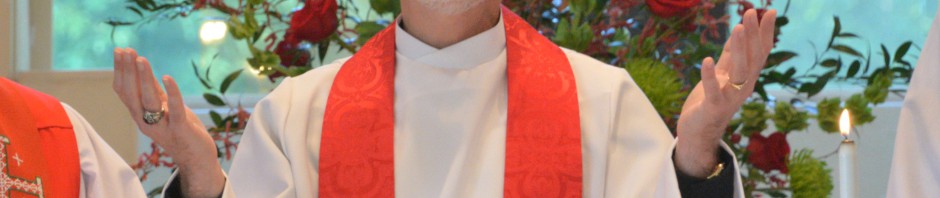

Holy Cross Day, 14 September, is a “Red-Letter Holy Day” in the Anglican Calendar, a day of expected, as contrasted with optional, observance. At Apostles Anglican Church we will observe the day at our Noon Eucharist and Healing Service on Wednesday, 13 September. There is historical justification for observance on the 13th, but you will have to attend the service or read the sermon online to learn what it is.
Historically, Holy Cross Day commemorates the rediscovery of Calvary and the true cross of Christ following the destruction and rebuilding of Jerusalem and the loss of many Christian holy site locations. According to tradition, it was St. Helena, the mother of Emperor Constantine, who uncovered the buried site of Calvary and, on it, the remains of three crosses. This is one of the stories I relate in the sermon:
While searching for Calvary, Helena noticed a large patch of an aromatic herb unknown to her. She felt compelled to dig in that spot and there she uncovered the wood from three separate crosses, perhaps those of the two thieves and Jesus. As an aside, that herb is what we call basil, from the Greek basileus meaning king. Many churches — mainly Orthodox churches — are decorated with basil plants in observance of Holy Cross Day.
What are we to make of stories like this? How are we to read them? Some might — some do — argue that they are “fond thing(s) vainly invented, and grounded upon no warranty of Scripture” (BCP 2019, Article XXII, p. 780), and that we should not tell them at all. Obviously, I disagree. The problem lies not in the stories, but in a poor and false way of reading them. Let me explain.
Such stories are not objective history, nor do they purport to be. In fact, I would contend that “objective history” is an oxymoron as our Western culture understands both the words “objective” and “history.” Objective implies an independent, unbiased observer who in no way interacts with what is being observed or reported. But such an observer is a fiction. All observing and reporting is subjective, because the observer or reporter is a subject — a who and not a what. Every reporter, every historian tells a subjective story. He (or she) selects some facts to include and some to omit. He selects some subjects to interview and others to ignore. He selects one or more themes that he wishes to emphasize and others to pass over. He structures the story in one way out of many possible options, ordering events and ideas to support his purpose in telling the story. This is how history is actually — and inevitably — done. And, this is precisely how the Gospels work. They make no pretense of being what we would call “objective” history; that literary form was unknown to the Evangelists. If in doubt about this, read St. Luke and St. John’s Gospels again carefully; the writers openly acknowledge that they come with an agenda and that they have interviewed people (in St. Luke’s case) and carefully culled available material (in St. John’s case) to accomplish their purposes in writing. That doesn’t mean that the Gospels are fiction! Far from it. What the Evengelists tell us happened actually happened. Jesus was conceived by the Holy Spirit and born of the Virgin Mary. He suffered under Pontius Pilate, was crucified, died, and was buried. On the third day he rose again. Yes, actually, factually. Still, this is not “objective” history because the “reporters” were subjectively involved with it; they built their lives upon it, and they wanted to convince the world about it. Further, Christian readers are not objective, nor should they be. We come to Scripture with a purpose:
to hear them, read, mark, learn, and inwardly digest them, that by patience and the comfort of your Holy Word we may embrace and ever hold fast the blessed hope of everlasting life (BCP 2019, p. 676).
Now, back to the story of St. Helena and the discovery of the true cross. Is that objective history? Of course not, and it does not purport to be. Is that a reason to reject it, to assess it as of no value to the church. I think not.
If the story is not objective history, then what is it and where does its value lie? I might describe the story as tradition, or sacred myth. A myth is a story — sometimes factual and sometimes not — that contains and teaches great truth. It is akin to parable. I suspect no one seriously thinks that the Parable of the Prodigal Son is factual history or that the Good Samaritan recounts an actual event. To insist on that is to miss the point. We understand the stories for what they are — not history but sacred myth. And we do not discount them for that. In fact, they stick with us and move us perhaps more than a didactic presentation of principles of forgiveness or neighborliness would do.
I do not know if St. Helena found Calvary or the wood of three crosses, and I do not care. The story is important nonetheless. Consider what it might teach us — and here I am scratching only the surface.
One of the earliest creeds was the simple but bold statement, “Jesus is Lord,” with the unspoken implication “and Caesar is not.” Well, the cross seemed to put the lie to that. The Roman persecution seemed to put the lie to that. But this simple story shows us Helena, the mother of the Roman Emperor, on her hands and knees digging in the dirt longing to find the cross on which the King of Glory — Jesus of Nazareth, King of the Jews — died so that she might honor it and worship him! “Jesus is Lord and Caesar is not” is the essence of the story: Rome on its knees in worship of the Jewish Messiah. Is that the truth? Is that a story worth telling? Creation was subjected to futility through the fall: thorns and thistles and the sweat of one’s brow. Here, in this simple story, the ground brings forth a living offering — not cultivated by man but offered by nature — to honor the King of kings, an offering with a sweet aroma. This points toward the new creation springing forth from the cross. Is that the truth? Is that a story worth telling?
Reading Scripture, the Fathers, and the Great Tradition well is an art that must be practiced and cultivated. It is not easy. It demands a certain purity of heart, a hermeneutic of trust — a willingness to read the author on his/her own terms without importing an agenda of one’s own and without distorting the text for personal motives. It requires humility. The best way to learn to read this way is to read with the church.


 First Blessings